
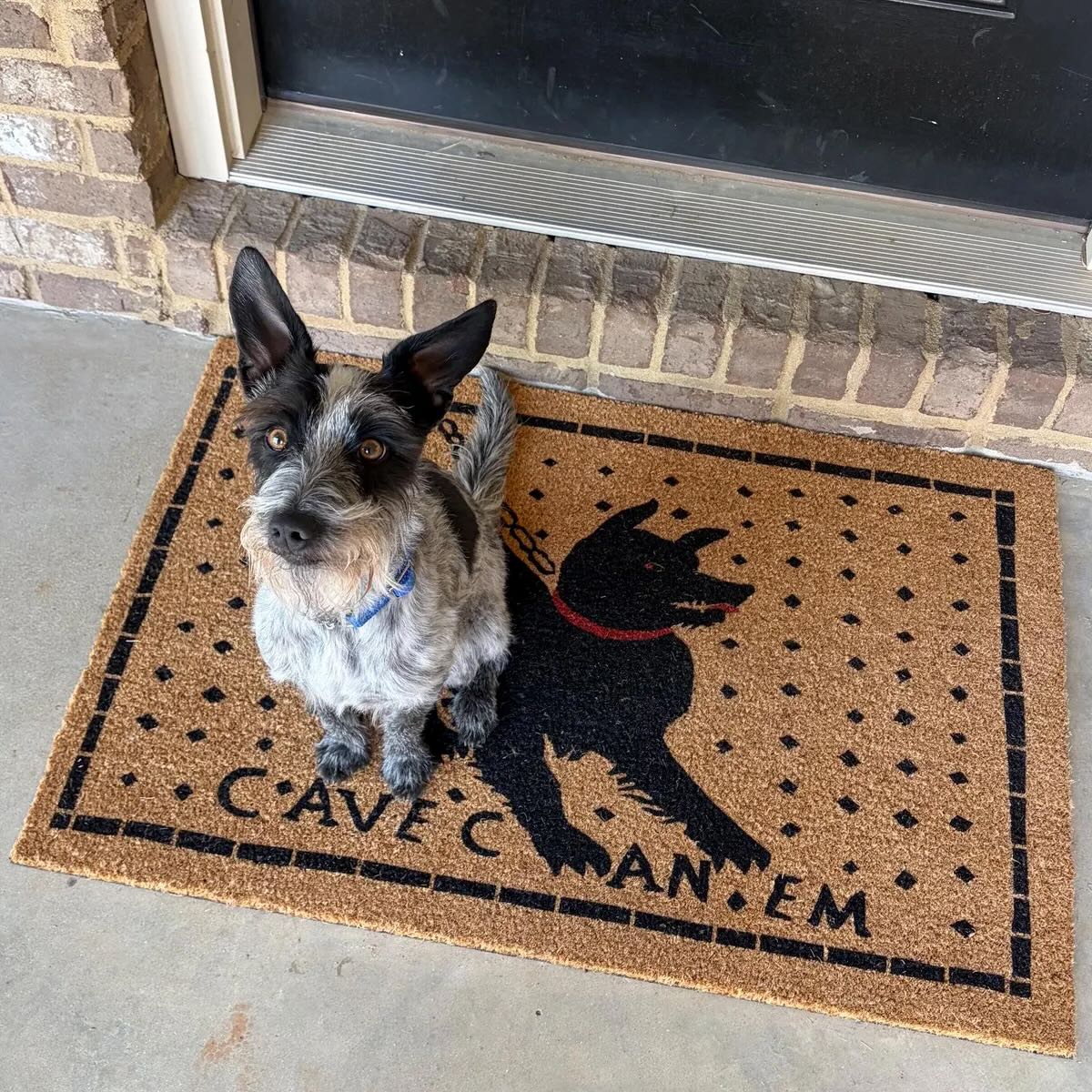
In 1984 I was a high school kid at the North Carolina School of the Arts, sitting in an art history class I had no business being as obsessed with as I was. The teacher was Harry Titus. He was a professor at Wake Forest and he came over to teach high schoolers because he wanted to, which at fifteen I did not understand and at fifty-something I understand completely.
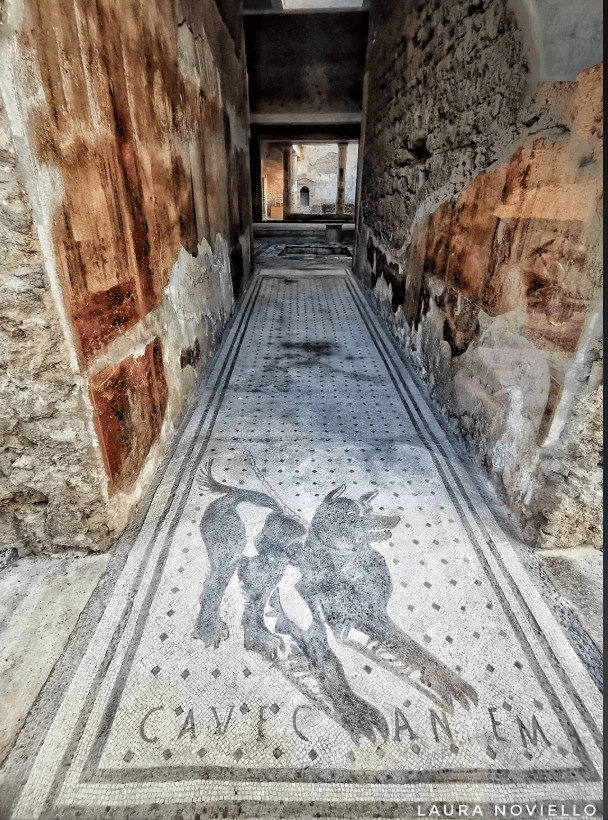
He taught us Rococo architecture. He taught us the difference between Ionic and Doric columns, which I can still tell you cold. And one day he put up a picture of a black and white mosaic from a doorway at the House of the Tragic Poet in Pompeii, a dog on a chain, teeth out, with two words underneath it.
Cave canem.
What cave canem actually means
Cave canem is Latin for beware of the dog. Cave is an imperative, roughly "watch out for," and canem is the dog, in the accusative because the dog is the thing you are being warned about. So the cave canem meaning is not poetic or mysterious. It is a guy telling you there is a dog and you should plan accordingly.
Which is the part that got me. Two thousand years of empire, philosophy, aqueducts, and somebody at the front of a house in Pompeii thought the most important information a visitor needed was: dog.
The mosaic is real and it is still there
The famous one is in the House of the Tragic Poet in Pompeii, set into the floor of the entryway. It is a pompeii mosaic dog, black tesserae on white, chain around its neck, front legs braced, mouth open. It was made before 79 AD, because in 79 AD Vesuvius erupted and the whole city stopped.
Somebody commissioned that. Somebody was paid to make it. A person laid those tiles one at a time on their knees so that anyone standing at that door would look down and get the message.
That is a doormat. That is exactly and only what a doormat is. The beware of dog latin version is just the oldest one we have a picture of.

Harry Titus taught high school kids on purpose
I want to stay on him for a second.
He was on sabbatical and he chose to spend it in a room with teenagers. He specialized in French Gothic cathedrals and he used to take students to France so they could stand inside the buildings instead of looking at pictures of them. That is the same instinct as putting a real mosaic on a screen in front of fifteen-year-olds. He wanted you to see the actual object, made by an actual person, and he was completely uninterested in whether you were the right age to appreciate it.
I did not become an art historian. I make doormats for a living. But every single thing that man taught me stuck, and one of those things has been paying my mortgage for years.
Why the Romans put it at the threshold
Here is the part I think about most.
A Roman house had a vestibule, and the floor of that vestibule was where you told people what kind of house they were entering. Sometimes it was a welcome. Sometimes it was a warning. Sometimes it was a flex about how much money you had. The threshold was understood to be a place where a message goes, and everybody knew to look down.
That convention never went away. We just got worse at it. We went from a commissioned mosaic to a yellow plastic triangle from the hardware store. My whole business is an argument that we should go back.
The people who buy it have usually been there
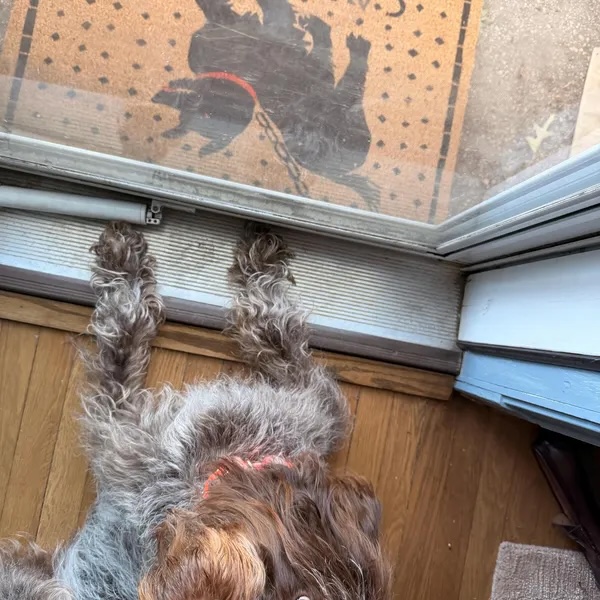
This is the thing I did not expect. A large share of the people who buy a cave canem doormat have stood in front of the real one.
They walked through Pompeii on a trip, went past the House of the Tragic Poet, looked down, and could not stop thinking about it. Then they got home and went looking. I have reviews from people who honeymooned there. It is a souvenir bought weeks late, from four thousand miles away, which is the strangest and best kind of purchase.
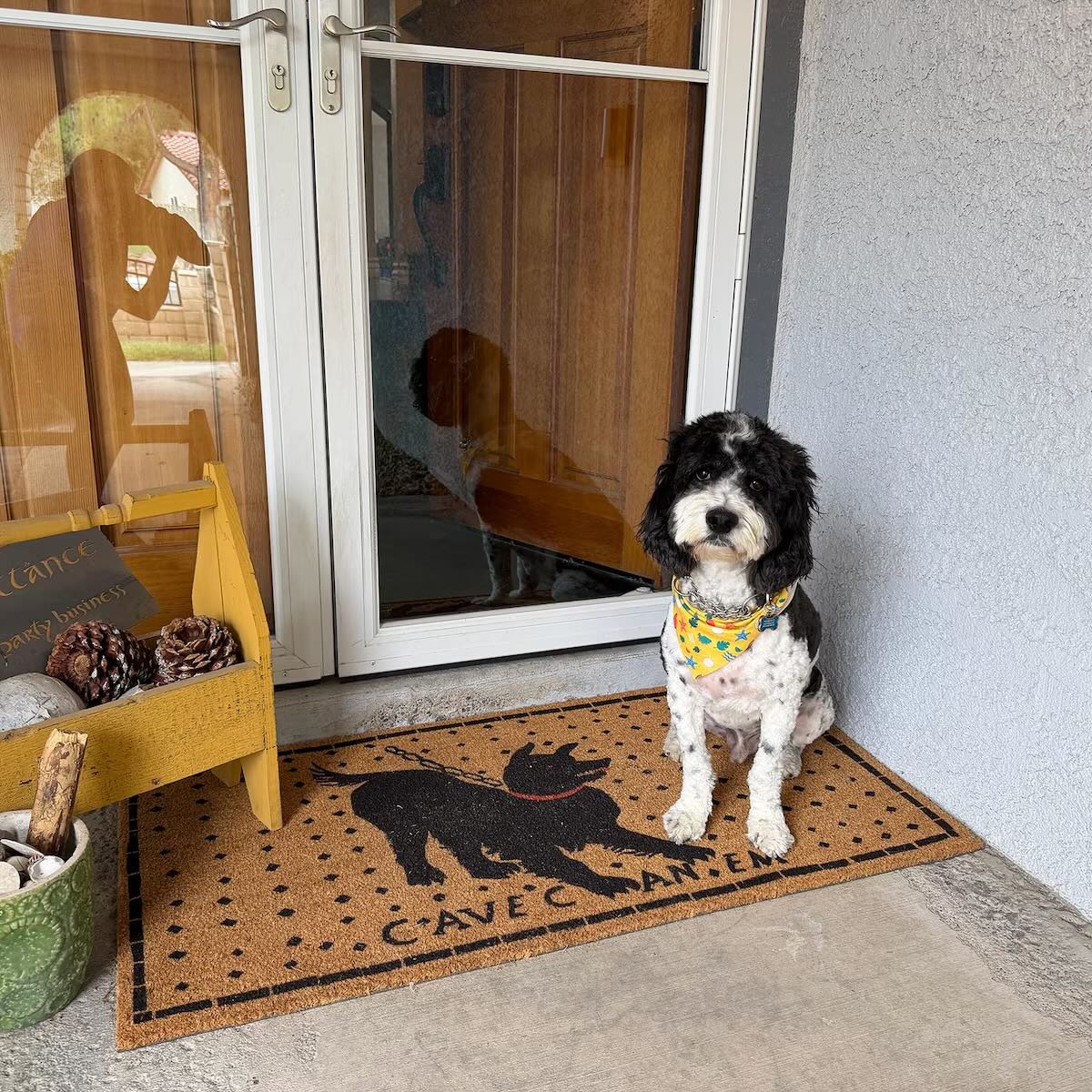
The rest are art history people, Latin teachers getting a gift from a student who paid attention, and dog people who like the idea that their dog is part of a two-thousand-year tradition of being a liability.
A few of my favorites, exactly as written:
- "I am a big History buff, and seeing this in a picture from Pompeii. It is awe-inspiring."
- "A great gift for my parents who love dogs and studying history. Shipped fast as well!"
- "GREAT DOORMAT THAT ANY FAN OF THE ROMAN EMPIRE WOULD LOVE!!"
- "As a contemporary replica, the doormat is in no way inferior to the ancient model: creative, high-quality manufactured and you don't even need to be a dog owner."
That last one is my favorite review I have ever gotten, and I did not pay for it.
I never told him
Harry and I stayed in touch for a while. Not for long enough, and not into the years when this became a business.
He died in June of 2024. He was 81. He had taught at Wake Forest for thirty-two years and retired in 2013, and I found all of that out the way you find things out now, which is too late and on a screen.
So he never knew. He put a mosaic up in front of a room of art school kids in 1984 and one of them built a life partly out of it, and there is no version of this where he gets to hear that. I can't fix it. I can keep making the mat and I can put his name in the same paragraph as the mosaic, which is the only thing I have.
Get one
The Cave Canem doormat is UV printed on natural coir with high-quality inks, same as everything I make. There is also a Cave Catus for households where the actual threat is a cat, which the Romans failed to warn anyone about and which I consider an oversight.
If you want something else in Latin, or the dog's name under it, or a mat for a Latin teacher retiring after thirty years, I take custom orders. Tell me what you want it to say.
More in this vein over at nerdy doormats, and the rest of the shop is at Damn Good Doormats, where a queer woman has been making this stuff since 2009.
Be well and enjoy wiping your feet!
Spoon
